Key takeaways
- A curve often rotates the rib cage, so the head has to turn a little further for every mirror check. Over a commute, that adds up.
- Sitting loads a curved spine unevenly, and a driver's seat is a sitting position you cannot adjust for an hour at a time.
- Seat height, lumbar support, headrest height, and mirror placement are the four adjustments that matter most.
- The roads that tire a curve, the stop-and-go on I-70, I-64, Route 364 and Highway K, are also where rear-end hits happen.
- After any bump, a driver with a curve should get examined this week rather than waiting to see how the neck feels.
There is a version of the St. Louis metro that only commuters know. It is the morning lineup at the Route 364 bridge, the brake lights on I-70 east of the Blanchette Bridge, the long crawl on I-64 where Chesterfield valley narrows, and the stop-and-go on Highway K past every shopping center in O'Fallon. Readers with a curve know that version of the metro in their necks. This dispatch is about why, and about what to do when the crawl turns into a bump.
Why driving costs a curve more
Two things happen in a driver's seat that a curved spine handles worse than a straight one. The first is sitting. A seated spine loads the lower back and the discs more than a standing one does, and a curve, which already distributes load unevenly, has no way to shift it around; the convex-side muscles simply work harder for the length of the drive. The second is rotation. Many curves come with a degree of rotation of the rib cage, which means that to check a mirror or a blind spot, the head and neck have to turn a little further than a symmetrical body would. Once is nothing. A thousand times between O'Fallon and Clayton is a sore neck by the parking garage.
Add a headrest set for a different body, a lumbar support that was never adjusted, and a seat that is a little too low, and the drive becomes the most reliable daily aggravator of the everyday ache. We wrote about that ache in general in its own dispatch; this one is about the car.
Four adjustments that matter
- Seat height. High enough that the hips are level with or slightly above the knees. A low seat folds the lumbar spine and loads the apex of a lumbar curve.
- Lumbar support. Set so it fills the small of the back without pushing. For a lumbar curve, it may need to sit slightly off-center; experiment on a short trip, not a long one.
- Headrest height. The National Highway Traffic Safety Administration has long emphasized that a head restraint positioned close to and level with the back of the head reduces whiplash injury in a rear impact. For a driver with a curve whose head sits a little forward or to one side, it is worth checking that the restraint is actually behind the head rather than behind the neck. NHTSA publishes its guidance at nhtsa.gov.
- Mirrors. Set them so that a glance, not a turn, covers the lane. Wider-angle side mirrors reduce the number of full head turns a rotated spine has to make.
The roads that tire a curve are the roads where hits happen
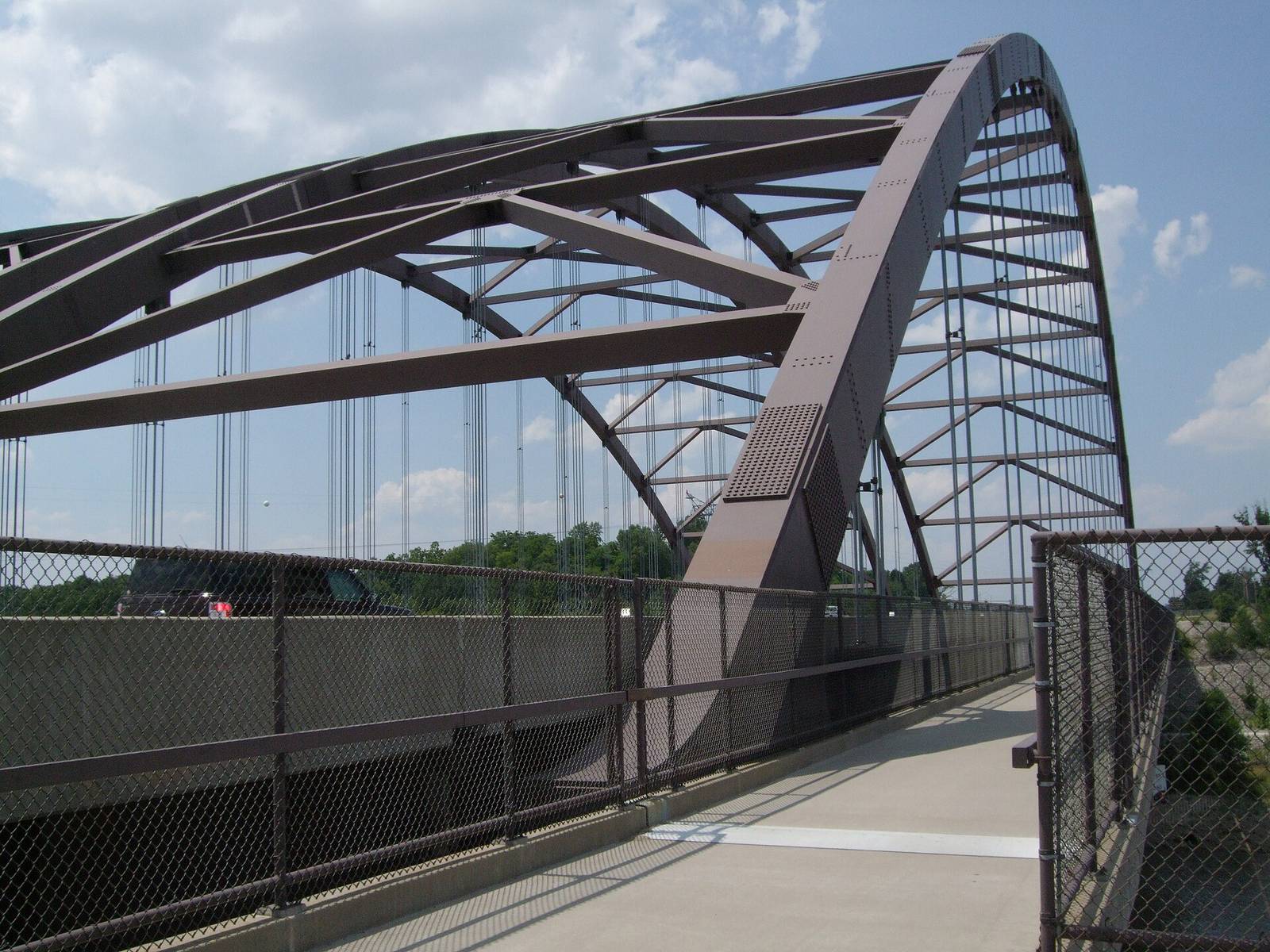
The same corridors that wear on a curve are the corridors where low-speed rear-end collisions cluster: the places where traffic compresses and drivers look at phones. The Route 364 crossing in the photograph is one of them. The approach to the Blanchette Bridge on I-70 is another. Highway K and Mid Rivers Mall Drive through O'Fallon and St. Peters, with a traffic light at every shopping center entrance, are where our readers report the bump that came out of nowhere.
A low-speed hit is not a small event for a neck. A whiplash-type motion, as the National Institute of Neurological Disorders and Stroke describes it, is a rapid back-and-forth of the head that strains the soft tissue of the neck, and it does not require a dramatic crash. A parking-lot speed tap from behind, with the head turned to check a mirror, on a neck that was already working harder than average, is enough. And because soft tissue runs late, the driver who said "I'm fine" on Highway K often wakes up differently on Tuesday, a pattern we lay out in the slow week.
Where the offices are, relative to the roads
Missouri Injury Clinic keeps three offices, and they happen to sit on three of the metro's commuting corridors. The Lake St. Louis office at 2163 West Terra Lane in O'Fallon, (636) 280-0990, serves the 364, 70, and Highway K commuters west of the river. The North County office in Hazelwood, (314) 627-1411, is near the I-270 and I-170 corridors. The South County office on Tesson Ferry, (314) 530-5480, is off the I-270 and I-55 side of the county. Pick the one you can actually reach this week; all three close from 12 to 2, and the offices page has hours and links for each.
The bright line on the road
Chest pain, a sudden severe headache, weakness or numbness on one side, trouble speaking, a loss of bowel or bladder control, or a head injury with vomiting or worsening confusion is an emergency room trip right now, not a call to a clinic. If any of that is present after a crash, the emergency room is the only correct destination, and the clinic exam comes later.
The long view, resumed
Most of the time, the commute is just the commute. Adjust the seat, set the mirrors, take the break at the halfway point if the drive is long, and go back to living around the curve the way you always have. The one exception is the bump. For that, hurry once, and then be patient again.
Hurry once, then be patient again.
After any bump on the commute, get examined this week with your curve named first. A documented exam protects your health and your options, and you do not need to have decided anything about a claim to get one.
Missouri Injury Clinic · Joseph L. Hollingsworth, DC · offices close 12 to 2 · all offices
Advertising disclosureThis page is advertising. This desk is compensated for featuring Missouri Injury Clinic, and it is not the clinic, not a law office, and not a party to anyone's insurance claim. We publish only the lanes, offices, and hours the clinic publishes on moinjuryclinic.com. We do not write reviews, rank providers, or give medical or legal advice.