Key takeaways
- Scoliosis is a sideways curve of the spine, conventionally diagnosed at a Cobb angle of ten degrees or more on a standing film.
- Most curves have no known cause. Many are found during adolescence; some develop in adulthood from ordinary wear on discs and joints.
- Mild curves are usually monitored rather than treated. Bracing is mainly for growing children with moderate curves. Surgery is reserved for large or progressing curves.
- Pain is not a function of degrees alone. Plenty of people with small curves hurt and plenty with large ones do not.
- A chiropractor can examine, document, and treat the everyday complaints of life with a curve. Nobody on a webpage can promise to straighten one.
The first number most people with a curve ever learn about themselves is a number of degrees. It arrives in a pediatrician's office or after a school screening, and it is usually said quickly, as if it explained everything. It does not. A curve is a structural fact, and like most structural facts about a body it is more useful as a trend than as a snapshot. This dispatch is the slow one, the one to read on a quiet evening, about what that number means and what it was never meant to mean.
How a curve is measured
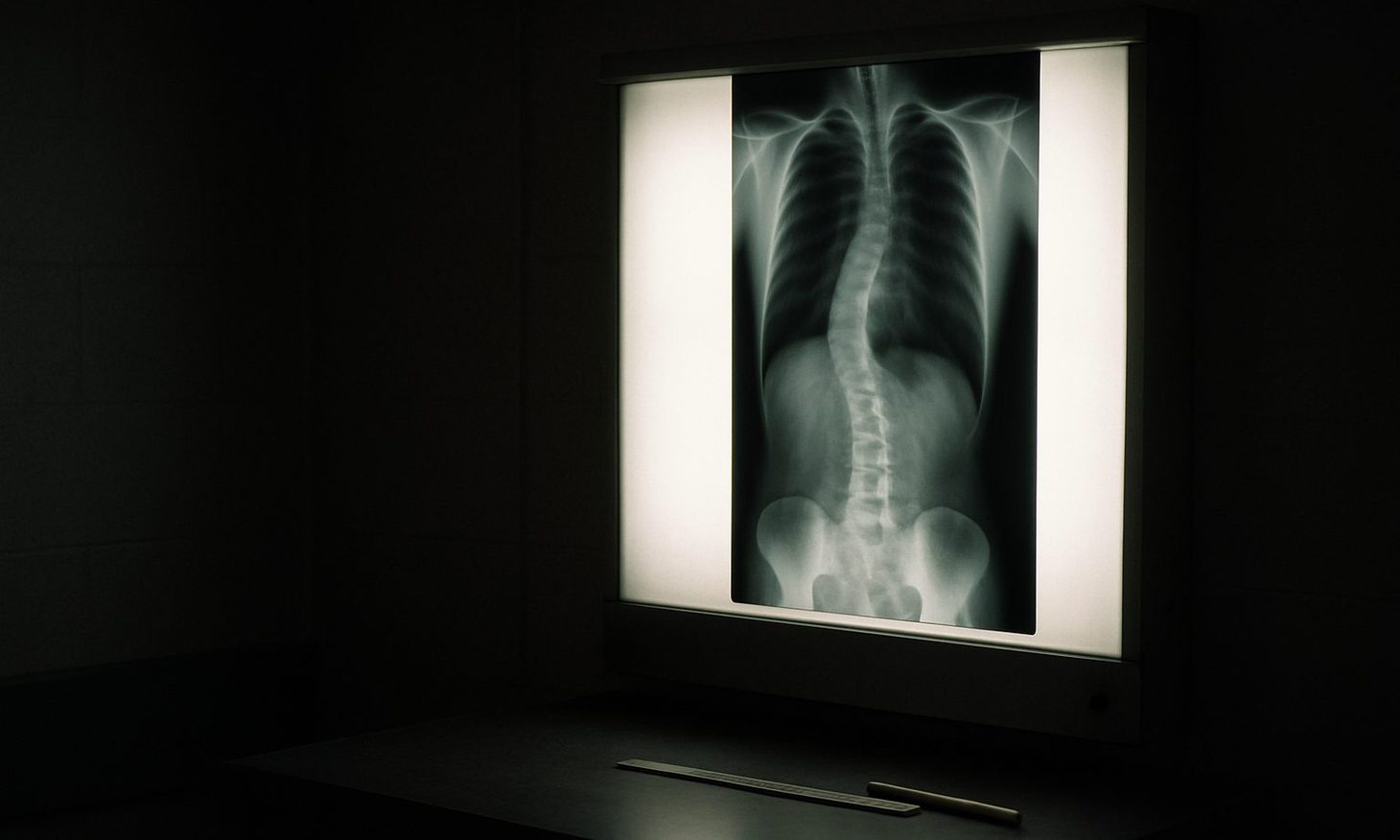
Scoliosis is a sideways curvature of the spine, most often in the shape of an S or a C when seen from behind. It is measured on a standing x-ray using the Cobb angle: a clinician identifies the most tilted vertebra at the top of the curve and the most tilted vertebra at the bottom, draws a line along the end plate of each, and measures the angle between them. By long convention, a Cobb angle of ten degrees or more is called scoliosis; smaller asymmetries are common and usually not called anything. The National Institute of Arthritis and Musculoskeletal and Skin Diseases keeps a plain-language overview on its scoliosis page, and MedlinePlus has another.
Two things about the measurement are worth knowing. First, it has a margin of error; the same film measured by two careful people, or by one person on two different days, can differ by a few degrees, which is why a single small change is rarely treated as meaningful. Second, it is taken standing, which means posture, fatigue, and even the time of day can nudge it. This is why your clinicians have always cared more about the direction of the trend over years than about any single number.
Where curves come from
Most scoliosis is idiopathic, which is the clinical word for "we do not know why." It tends to be noticed during the growth years and is more often found in girls than boys, though it occurs in both. A smaller share of curves are congenital, present from birth because of how the vertebrae formed, and some are neuromuscular, related to conditions that affect the muscles that hold the spine up.
Then there is the curve that arrives in adulthood. Some adults simply carry an adolescent curve forward, and it has been part of them for forty years. Others develop what clinicians call degenerative, or de novo, scoliosis: the discs and small joints of the lower back wear unevenly over decades, and the spine settles into a curve it never had before. Many of our readers are in this second group, and they are often surprised to learn that a curve can be a new fact at fifty-five.
What the number does and does not predict
Degrees predict some things reasonably well. Larger curves in growing children are more likely to progress, which is why bracing exists: a brace does not straighten a curve, it aims to keep a moderate curve from getting larger while the skeleton is still growing. Very large curves can crowd the chest and affect breathing, which is one of the reasons surgery is considered for them. Those are real relationships, and they are the reason follow-up films matter for a teenager.
Degrees predict pain poorly. Plenty of people with small curves have a lot of back and neck pain, and plenty of people with large curves have very little. Pain in a spine with a curve has more to do with the muscles working unevenly, the joints at the apex wearing faster, the hips and shoulders compensating, and everything else a person does with their day. We devote a whole dispatch to the everyday ache because it is the part of life with a curve that the number never explained.
What care looks like across a life
For a mild curve, care usually means monitoring: a film every so often while growing, and then, for most adults, nothing scheduled unless something changes. For a moderate curve in a child who is still growing, bracing may be recommended. For large or clearly progressing curves, surgery is discussed, and that conversation belongs with a spine surgeon, not with this desk.
For the far larger group, the adults living around a curve that is not going anywhere, care is about the everyday: the stiff mornings, the side that always aches, the neck that complains after a long drive, the flare after a weekend of yard work. That is where a chiropractor can help in concrete ways. Joseph L. Hollingsworth, DC, at Missouri Injury Clinic, examines spines, documents what he finds, and treats pain and injury; the clinic's published lanes are auto injuries, TBI and concussion rehab, and sports injuries. What no clinic can do from a webpage, and what this publication will never promise, is to straighten a curve. Be wary of anyone who does.
Why the baseline habit matters later
Living with a curve teaches you that a measurement on a known date is worth more than a memory. That habit, which you built for the curve, is exactly the habit a crash requires. If a car ever rolls into the back of yours, the person who has always kept the folder of films is the person best equipped to get a prompt, dated exam and add one more page to it. The record is about that page, and the curve is about why the week after a wreck is the one time the long view should be set aside.
A word on the bright line
Slow reading is not an excuse for slow reaction. Chest pain, a sudden severe headache, weakness or numbness on one side, trouble speaking, a loss of bowel or bladder control, or a head injury with vomiting or worsening confusion is an emergency room trip right now, not a call to a clinic. That is true with a curve and without one.
Questions about your curve belong in an exam room.
This page is reading. It cannot measure anything. For the everyday complaints of life with a curve, and for the one week after a crash, Missouri Injury Clinic examines, documents, and writes a plan.
Missouri Injury Clinic · Joseph L. Hollingsworth, DC · offices close 12 to 2 · all offices
Advertising disclosureThis page is advertising. This desk is compensated for featuring Missouri Injury Clinic, and it is not the clinic, not a law office, and not a party to anyone's insurance claim. We publish only the lanes, offices, and hours the clinic publishes on moinjuryclinic.com. We do not write reviews, rank providers, or give medical or legal advice.